

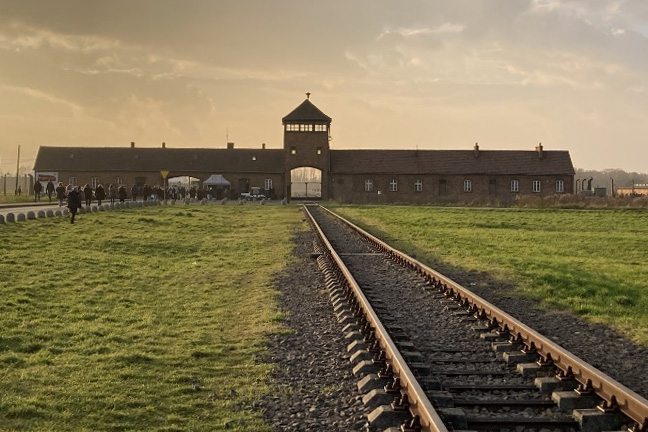
The Holocaust: Why is it important to remember?
The Holocaust is widely considered one of the most tragic events in recent history – and that is an issue. Confining the Holocaust to ‘history’ is a common mistake for a couple of reasons: firstly, the persecution
of minorities is very much ongoing, and with all that has happened within countries such as Ukraine and Iran, it is more important than ever to understand people’s fight for identity and freedom. Secondly, we are the last generation who will be able to hear first hand testimonies from Holocaust survivors, and therefore we need to listen and keep their memories alive – it would be disrespectful not to. It is also important to note that all those involved in the Holocaust were human beings, which includes the perpetrators. In this article, I will be sharing what I learned on my trip to Auschwitz through what I was told personally, to put faces to the statistics; impersonal information from textbooks limits our understanding of what really happened. All I ask is that you take away some additional knowledge, if nothing else.
The Role of the Camps: Life for Jews in Auschwitz
It’s important to first understand the role of concentration camps, and why minorities were sent there. Although Auschwitz is arguably the most notorious death camp,

Luggage taken to Auschwitz by its prisoners.
there were many others with the same motives: to kill ‘lebensunwertes’, anyone deemed ‘unworthy of life’ by the Nazis. Jews were at the top of this list, but other victims included Roma/Sinti people, Slavic people and homosexuals.
The camps relied on degrading their victims by giving them squalid living conditions and forcing them to do hard labour – although Jews, as the group most loathed by Nazis, were banned from practising any aspect of Judaism, in order to crush both their religion and their morale. As I saw from the personal possessions left behind at Auschwitz, religion was a key aspect of life for many Jews, and they did not realise that they would be banned from practising their faith.
A major part of the camp’s role was to do with dignity; to the Nazis, it may have seemed easy to strip away, but this was ultimately in the control of each prisoner. In retaliation, Jews would try to wash and look presentable, and beyond that, would share and display their religion as much as possible. Ultimately, they were defying the generalisations given to them by the Nazis and were carving out their identities, showing that they were much more than the numbers tattooed on their wrists, or the statistics in today’s books.
Manfred Goldberg – A Survivor’s Testimony
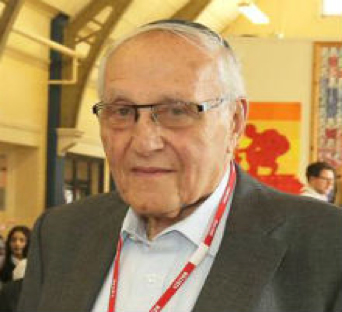 Understanding the first-hand testimonies of Holocaust survivors is crucial, as the best way to understand the victims as human beings is to hear their stories directly – and as the final generation of people who will be able to do this, we should be paying attention more than ever. I was fortunate enough to listen to Manfred speak of his experiences live over Zoom, experiences that deserve to be heard by as many people as possible.
Manfred Goldberg was born on 21 April 1930 in central Germany – he was just nine years old when the Second World War began. He and his family were facing intense persecution in the buildup to the war, and Manfred’s father managed to escape to Britain mere days before it began – tragically, Manfred, his mother and his younger brother were unable to join him.
Manfred, along with his mother and brother were transported to the Riga Ghetto, Latvia in 1941, where Manfred narrowly escaped death when a man who he described as ‘an angel’ told him to lie about his age so that the camp would find a use for him. Unfortunately, Manfred’s young brother was not so lucky. Manfred was then sent to a nearby labor camp where he had to lay railway tracks; camp prisoners were constantly subjected to selections, in which those found to be weakened by the back-breaking work were executed.
As the Red Army began to approach Riga, all the surviving prisoners were relocated to Stutthof concentration camp in Poland, where Manfred was forced to be a slave worker until the camp was abandoned days before the end of the war; as a result, the surviving prisoners were sent on a death march before finally being liberated on 3rd May, 1945 in Neustadt, Germany. He was later reunited with his mother, and eventually his father when he moved to Britain in September 1946.
Manfred also told us about how his experiences during the Holocaust affected his faith, mentioning that the horrors he had experienced made it difficult to accept the idea of God. That being said, once safe from his past experiences, he began to see beauty in the world again, which helped him to rekindle his religious roots.
The Perpetrators – Can they all be blamed for their actions?
Whilst in Auschwitz, I was told about the case of Rudolf Höss, an SS officer and the longest serving commander of Auschwitz’s extermination camp. He also lived inside Auschwitz – with his wife and children. This becomes more shocking when you realise that their house was just metres from the gas chambers; prisoners, in the moments leading up to their death, would have been able to look over at the large private property, a final insult to their lives.
As bizarre as it might seem to bring your young family to live in a death camp, it makes sense upon closer inspection: Höss was partaking in his country’s war in uncertain times – why wouldn’t you want to be close to your family, in case the worst were to happen? It’s a highly human response, which seems ironic given his role in the millions of deaths that occurred. Whilst he chose to do what was best for his family by obeying orders and keeping them close to him, it is still important that we hold him accountable; like many of the perpetrators, whilst his actions can be explained, they cannot be justified.
“My family had it good in Auschwitz, every wish that my wife or children had was fulfilled. The children could live free and easy. My wife had her flower paradise… There was always something new and interesting in the garden.” – Höss, 1947
The Contemporary Relevance of the Holocaust: Discrimination in today’s world
Even nowadays, the Holocaust still holds great importance – but why? This is a big question with a wide range of answers, but to put it simply, it helps us to understand the causes and consequences of hatred – whilst this relates to antisemitism, it also applies to other forms of discrimination too.
In recent years, there has been a growth in the number of violent acts motivated by racism and religious intolerance – the Community Security Trust (CST) recorded 1,668 incidents involving antisemitism in 2020 in the UK; such hatred neither began nor ended with the Holocaust. In the same year, a spokesperson for Tell MAMA (a UK-based reporting service for acts of Islamophobia) explained that “some in our society easily blame others for issues that affect us all and that sadly, prejudice is still alive and well.”
This is a sad reality, and the fact that the amount of such abusive behaviour is on the rise needs to be carefully understood. This is why sharing information about past tragedies, such as the Holocaust, is vital – people can only grow from their mistakes if they understand why they are wrong and the impact they can have in the grand scheme of things.
written for Bexclusive Magazine by Genevieve Kidd


