Isis Rees looks at the stories behind the statistics
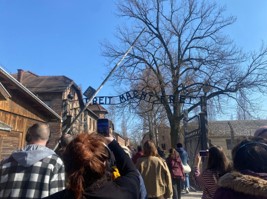
I recently took part in the Lessons from Auschwitz Project, organised by the Holocaust Educational Trust. The project was comprised of an in-person orientation seminar, followed by a one day visit to Auschwitz-Birkenau in Poland, ending with an online seminar where we discussed our experiences. It was a transformative experience which opened my eyes to the importance of Holocaust remembrance, both now and in the years to come. The experience expanded my understanding of its history in many ways, but the lesson that impacted me most profoundly was how the story of each victim is much more powerful than any statistic.
We might be told in school that 6 million Jewish men, women and children lost their lives. However, a focus on statistics alone prevents a true understanding of why and how the Holocaust occurred. Behind each of the six million people murdered at the hands of the Nazis is an individual human experience, many of which are often not brought to the surface. This was the focus of our orientation seminar, where we studied an array of different victims of the Holocaust living all across Europe. I found myself overwhelmed by the sheer number of stories that I was presented with. Each person lived a distinctive and vibrant life, unaware that it would soon be snatched from them.
A photograph I remember well is of Berta Rosenhein, posing for her first day of school in Leipzig, Germany, in 1929. She is holding a Schultüte, a traditional German cone full of confectionary, with a big smile on her face. Another example was Ota and Katerina Margolius, a young newly married couple living in Prague during the early 1930s. I later learnt that Ota and Katerina were due to be transported to Auschwitz with their daughter Ines, but before their departure Ota was forced to bury the bodies of those who had been murdered inside Terezin, the ghetto which they were inhabiting. Ota was then murdered in Terezin. Katerina and Ines were taken to Auschwitz and thankfully survived, but carrying the burden of unimaginable trauma and loss.
As I read these accounts, I realised that I had too often only thought about victims of the Holocaust as one group, failing to consider their individual experiences. During our group discussions, the importance of restoring power to victims of the Holocaust through the recognition of their personal narratives was something that we discussed extensively. It is only through drawing attention to these stories that we can begin to comprehend the extent of the suffering inflicted upon innocent human beings, in whom we may see aspects of ourselves. By learning about the Holocaust through the personal perspective of its victims, we can strip away power from the Nazis and their attempts to suppress the identities of Jewish people.
During our time in the main concentration camp, Auschwitz 1, we were taken through a series of museum rooms. I had previously been aware of some of the exhibits, such as a display case containing the shoes of people murdered at the camp, but seeing them in person was a more emotional experience than I’d anticipated. Not only did we see the shoes of real victims, but mounds of stolen suitcases and glasses too. Finally, perhaps most horrifically, we were taken into a room which contained human hair, taken from each person upon their arrival at the camp. In my group, we discussed the idea that the Holocaust is not only the greatest mass murder in history, but also the greatest theft. The Nazis and their collaborators stripped each person who arrived in the camp of their property and sold it, using this money to fund their plans for mass extermination of the Jewish population.
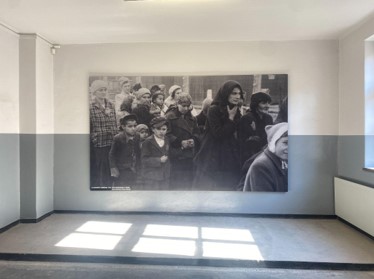
We also saw photographs taken from inside the camp. The one that resonated with me most powerfully was of an elderly man being pointed in the direction of a gas chamber by an officer upon arrival to Auschwitz, unaware that he was being sentenced to his death. It served as a haunting reminder of the torture experienced by each individual, whether this was through an immediate, painful death or being made to carry out relentless, laborious work.
In the second camp, Auschwitz Birkenau, we were told the tragic yet empowering story of Viktor Frankll. Before being deported to Auschwitz in 1944, Viktor had worked as a psychiatrist in Austria. Upon arriving at the camp, his clothes were taken from him and he was given the coat of a deceased prisoner. When Viktor placed his hand into the pocket, he retrieved something that would entirely transform his perspective – a Jewish prayer. He begun to understand the power of finding hope and meaning, even in such a horrific and despairing place. Although the Nazis had seemingly taken everything from him – his clothing, his family, access to sufficient food – Viktor maintained the belief they could not take his spirit and determination to live. I found it extraordinary that in such dire circumstances, many prisoners were still able to find strength and inspiration through whatever meagre fragments of their old lives they could find. For example, women would often share recipes with one another before bed, showing the capacity human beings have to forge meaningful connections even in inhumane conditions.
By retelling these stories, I hope to remind people of the deep suffering endured by each and every victim of the Holocaust. Numbers alone can never capture the truth of those hardships that were experienced during this grave crime against humanity.