

A-Levels, T-Levels, BTECs: is it time for a change?
By Stevie Adams and Sofia Visco
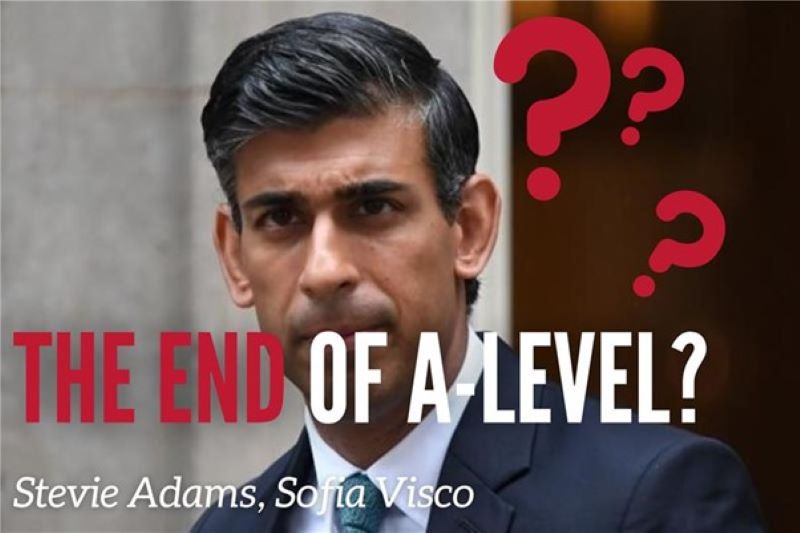
Rishi Sunak recently proposed plans to replace existing qualifications with a new system which he hopes will give students a more rounded education. Under the new plans, A-Levels which have been running since 1951, along with T-Levels which were only introduced in 2020, will be scrapped and students will study a minimum of five subjects including English and Maths under the Advanced British Standard. We asked two Bexhill College students, Imogen and Niccolò, for their opinion of Sunak’s proposal for the Advanced British Standard.
How do you feel about the current education system?
Niccolò
I think that in Italy the current school system is challenging in a different way than the English one. In fact, in high school, we have about twelve to thirteen subjects that vary according to the institution chosen. Subjects range from mathematics, Italian, philosophy and physics. This can lead to a much broader basic knowledge than the one given by the English system. In addition, in the Italian school system students are subjected to weekly written and oral examinations. The grade scale goes from 1 to 10 and the minimum grade that a student must obtain to pass is a 6. So, if at the end of the year a student has even one subject under the grade of 6, there’s the risk of having to repeat the whole school year. For this reason, I think that the Italian school system should really improve and keep up with current times.
Imogen
The current education system definitely needs improving, as it puts a lot of pressure on young people which results in negative effects on their mental health. The pressure isn’t necessary, and the decisions made at young ages like sixteen should be made when we are older, when we know more about what we want to do with our life. We have a lot of pressure on us to learn things that won’t benefit everyone. Not everyone needs to go into such depth in subjects like chemistry, not everyone wants to be a scientist.
How do you feel about doing A-Levels?
Niccolò
A levels, in my opinion, seem a much lighter system compared to the final exam we must do in Italy. In A Levels the exams all last about three hours each, and there is an examination for each subject whereas in Italy there are two written exams of six hours each. One is compulsory in Italian and the other varies from mathematics, languages and translation from Greek or Latin according to the chosen school. In addition, we also have an oral exam that includes all the topics of all the subjects carried out in the previous 5 years. That’s why A Levels don’t look so bad after all to me!
How would you feel about doing the ‘Advanced British Standard’?
Imogen
I don’t think it’s fair to make people do five subjects when many people struggle with just three A-Levels. Some people even struggle passing GCSEs so how is it fair to force them into this qualification which they will find even more challenging and intimidating? They would be being forced into something they just don’t want to do- which is just bad. Like GCSEs, not everyone will benefit from doing all of these subjects.
What changes would you make to the current system?
Niccolò
We definitely need changes in the Italian school system, not drastic, but at least immediate. In fact, the stress that it causes to students every day is very high, both for the number of subjects to be assessed and for the homework given for every one of them. I think we should find a middle ground between the English and the Italian systems. I think the English system, in fact, is too light and does not give the solid foundations that a complete education would leave. So maybe the Advanced British Standard would be a good middle ground.
Imogen
I would change the fact that GCSEs are made out to be such a big important factor in our lives, when they aren’t. People make it sound like if you don’t have GCSEs and other qualifications you won’t succeed in life. I think as long as you know enough to get your way through life you don’t need GCSEs. If you have a customer service job, it’s not important what’s written in an exam paper, you just need to be able to speak and communicate. I would allow people to leave school more easily at sixteen.
Do you think all students should do English and Maths until they are 18?
Niccolò
I believe that at least English is a subject that should be studied until the age of 18. GCSE Mathematics, when you know the basics, if you don’t want to pursue a career that requires special knowledge of it, is enough for any future job. But English, since it is the language spoken by all English people (and not only them), I also think it is necessary to know it better and to be able to use it at the right moments in the right way. Also knowing the etymology and the correct use of the words pronounced daily would help students to do better in exams and to find a future job, since they would be able to express themselves and understand better in both cases.
Imogen
No. As long as you’ve got the basics, I don’t think you should have to do it anymore. You can speak English anyway. It would be a waste of time if Rishi Sunak made you do this, as some people are better at doing something else such as practical skills. No one would benefit from learning stuff you don’t need to know and learning topics until you are eighteen that won’t actually benefit you in your everyday life.
So, these two opinions are representative of the range of responses that have been expressed across the country. However, with an imminent election looming it leaves the question of whether these plans will ever be put into place. Here at Bexclusive, we wonder that if more information was provided more people would come to a clear agreement (as of yet the information has been limited). So, what do you think should happen?
So, these two opinions are representative of the range of responses that have been expressed across the country. However, with an imminent election looming it leaves the question of whether these plans will ever be put into place. Here at Bexclusive, we wonder that if more information was provided more people would come to a clear agreement (as of yet the information has been limited). So, what do you think should happen?


